Review
A rigorous readingof your writing.
Like a sharp editor, Akston reads your writing for its argument, its evidence, its audience, and its prose. Findings come back ranked, each pinned to a passage. You decide what to change.
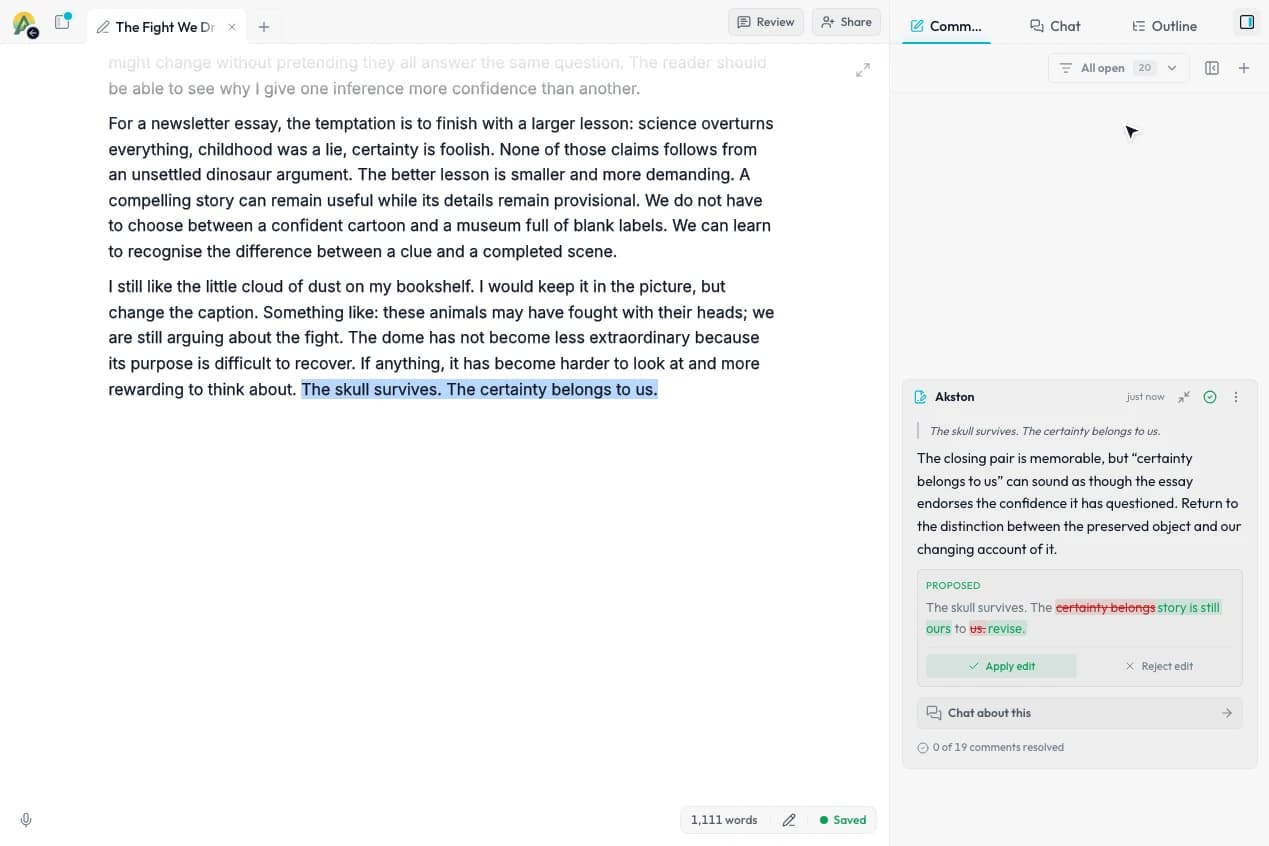
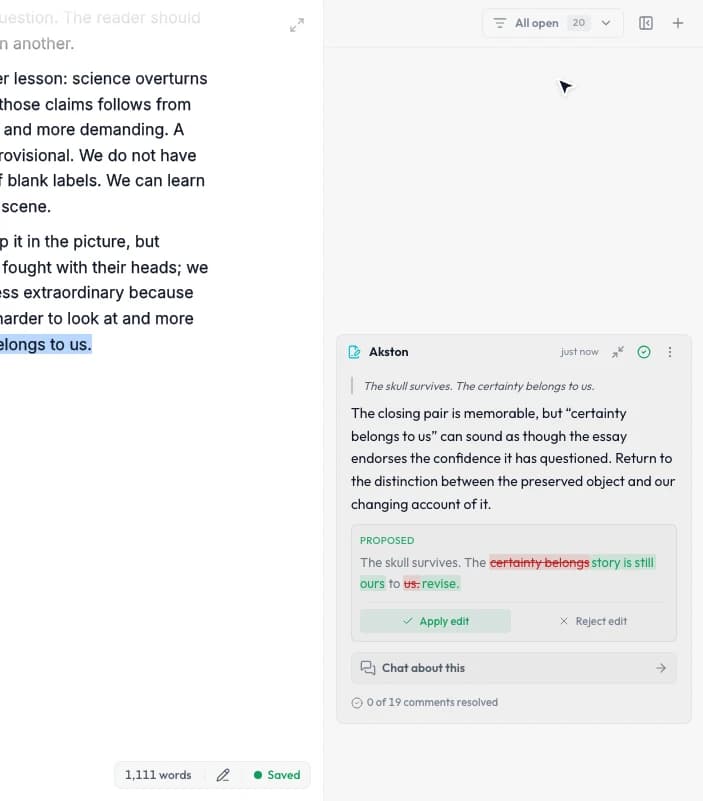
A writer requests a review of a 1,111-word nonfiction newsletter essay about dome-headed dinosaurs. Akston delivers twenty notes, including four sourced fact checks, editorial feedback, and an overall assessment. The writer opens an anchored disputed fact check, starts a chat about it, and gets wording that accurately distinguishes modelled capability from observed behaviour. Scripted demo; review time shortened. Automatically repeats while visible unless reduced motion is enabled.
Follow each note from the passage to the overall assessment.
Move between Akston’s overall assessment of your draft and the notes pinned to the exact sentences behind it. Nothing arrives as a generic score or a detached chat response.
It’s hard to see your own work from the outside. Akston gives you an independent editorial eye, on demand.
Editorial principles
Feedback worth acting on.
01
Feedback on what you’re saying, not just how you’re saying it.
Most writing tools stop at grammar and word choice. Akston also asks whether your argument works, whether your sections come in the right order, and whether each paragraph needs to be there.
02
Fewer notes, better ones.
Akston flags what would make a real difference to your draft, so the notes that matter don’t get lost among dozens of small ones.
03
The truth about your draft.
Akston is honest about what works and what doesn’t. It won’t flatter you or nitpick, but it will tell you what’s strong and where your draft can improve.
04
Every note tells you why.
A note is only useful if you understand it. Akston explains why each one matters, so you can decide whether you agree, fix it in your own words, and catch the same problem elsewhere.
The review process
Akston reads your draft four ways, then writes one review.
Argument
Does your draft make the case you think it makes?
Audience
Where will your reader follow, resist, or stop reading?
Evidence
Do your facts check out against real sources?
Prose
Where could your writing be clearer and more compelling?
Everything worth fixing.
Akston combines four editorial passes, drops repeats and contradictions, and ranks what’s left by how much it can improve your draft.
Every improvement you make is a problem your readers will never know about.
The whole argument
Akston maps your argument before it judges your draft.
It starts with what each part of your draft is doing: the promise your opening makes, the claims each section has to carry, and the conclusion your draft actually earns. Every later note refers back to that map.
The feedback covers your draft’s logic, not only its surface.
The reader on the other side
Akston reads your draft the way your audience will.
Akston considers what your readers already know, what it will take to persuade them, and where they are likely to push back.
Your draft can be right and still fail to convince your readers.
Evidence
Akston checks if your evidence supports your claims.
Akston finds the claims your draft depends on and checks each one against sources. Each claim comes back marked verified, disputed, or unverified, with its sources attached, so you can see what the verdict rests on.
Your readers can check your facts. Akston checks them first.
Prose
Akston tightens your prose without changing your voice.
Akston edits your sentences after it has read for your argument and your audience. It can cut a slow opening, fix an awkward phrase, or tighten a sentence, and still sound like you.
Every edit comes back as a suggestion on your passage, with the reason beside it. Accept it, dismiss it, or use it to write something better yourself.
Your argument is only as clear as the sentences that carry it.
From outline to finished piece
Akston reads an outline differently from a finished piece.
Akston first works out how far along your writing is, then adjusts what it looks for and what it leaves alone.
Strengthen your structure before you write the prose.
Akston reads your outline as the argument it will become, and points out where the logic will break once it’s written out.
Pays attention to: where your argument is headed, what it assumes, and missing steps.
Leaves alone: sentence polish, and the gaps an outline is supposed to have.
Akston reads your outline as the argument it will become, and points out where the logic will break once it’s written out.
Pays attention to: where your argument is headed, what it assumes, and missing steps.
Leaves alone: sentence polish, and the gaps an outline is supposed to have.
A fresh read
See your draft from the outside.
Bring your draft at any stage. Akston reads the whole piece and returns the feedback worth acting on. You decide what to change.