Research
Find out what’s truebefore you argue it.
Akston researches your subject, finds key facts, and helps you think about the main positions people are taking on it. It points you to the primary sources, so you can judge the evidence for yourself.
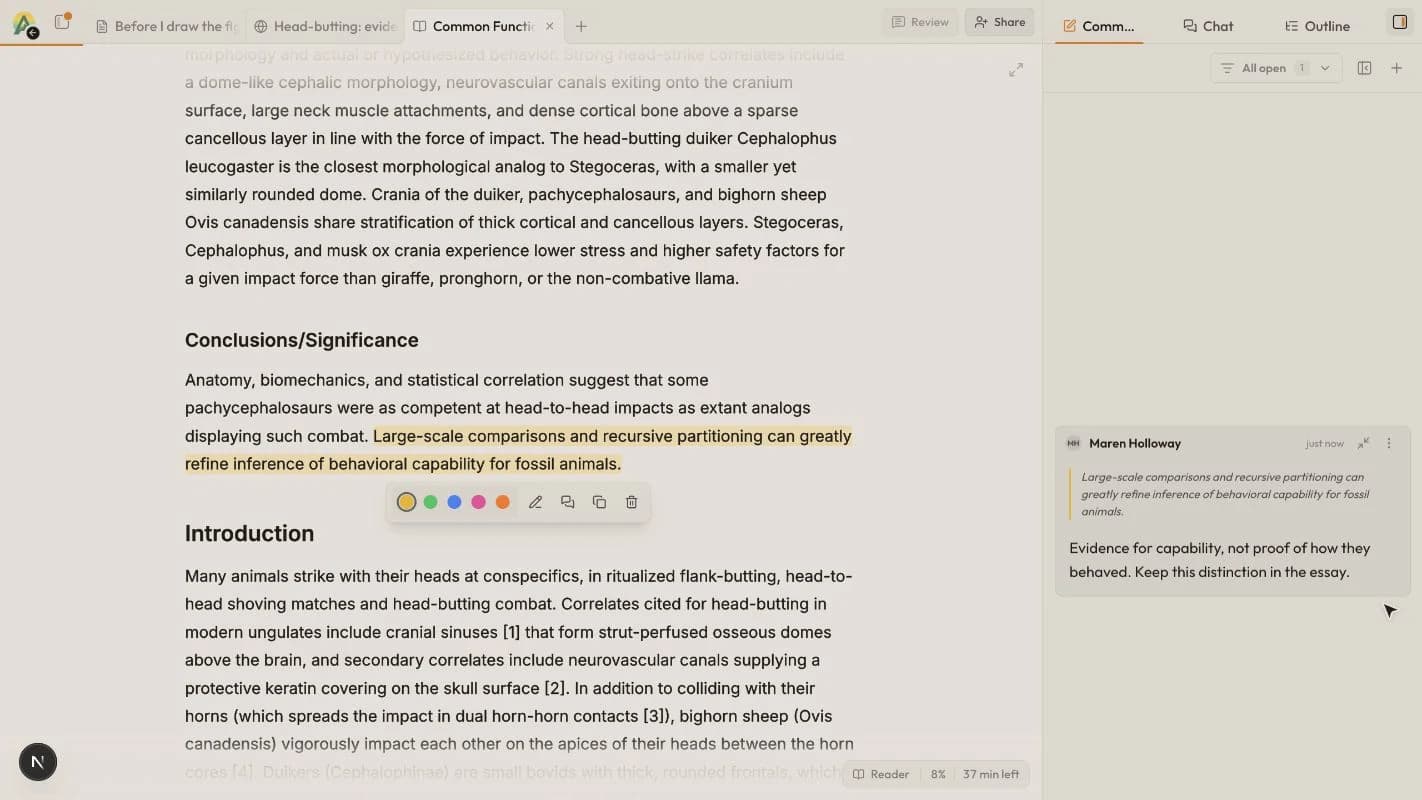
A writer researches head-butting in dome-headed dinosaurs. Akston examines twelve sources across injuries, biomechanics, growth, display and the limits of reconstruction, then creates an editable report that distinguishes evidence from uncertainty. The writer inspects a quoted passage, adds its source from the report to the project, opens the saved paper in Akston, and highlights the passage with a saved comment for their essay. Scripted demo; research time shortened. Automatically repeats while visible unless reduced motion is enabled.
See a serious question become a research report.
Watch Akston search, read, and write an editable report, with every source the report relied on linked from the text.
Research principles
What good research owes you.
A plausible answer is not enough. Research should help you weigh the evidence yourself, see where to look next, and choose which sources belong in your writing.
01
Start from your subject.
Tell Akston what you’re writing about. It works out what you need to know and looks for that, not everything ever written on the topic.
02
Hear from every side.
Akston looks for the strongest work on each side of the debate, not just the top search results.
03
See where sources disagree.
When sources disagree, Akston shows you who says what and why, instead of picking a winner for you.
04
Know what’s still unknown.
When the evidence runs out, Akston tells you, rather than filling the gap with a guess.
05
Choose your sources.
Akston tells you what each source offers. You decide which ones to add to your project.
A map of the evidence
See where the sources actually disagree.
Each report separates what is settled from what is still argued over, and names who holds each position, so you know how much weight a claim can bear before you make it.
Supported
What the strongest available evidence establishes.
Contested
Where credible sources part ways, and why.
Unresolved
What the sources found cannot yet settle.
Sources you can check
Keep the sources that matter in your project.
Akston can work from the sources already in your project as well as new ones from the web. Each passage it quotes links back to its source, so you can open it and read the surrounding text.
When a source is worth keeping, add it to your project with the reason it mattered and the useful passages still attached.
Follow-up research
Keep following what the first report reveals.
A useful report rarely closes the subject. Ask a follow-up, narrow your original question, or ask Akston for more sources where the evidence is thin.
Akston builds the next round of research on the sources it has already gathered, so you go deeper without starting over.
Follow the question
Start with a question worth following.
See what the sources say, check the evidence yourself, and go back to your draft knowing what you are responding to.