Challenge
Test your premise.
Akston looks for the assumption beneath your claim and asks the question that could change what your piece becomes.
Plan
Akston helps you question your premises and work out what your argument needs to be both true and convincing.
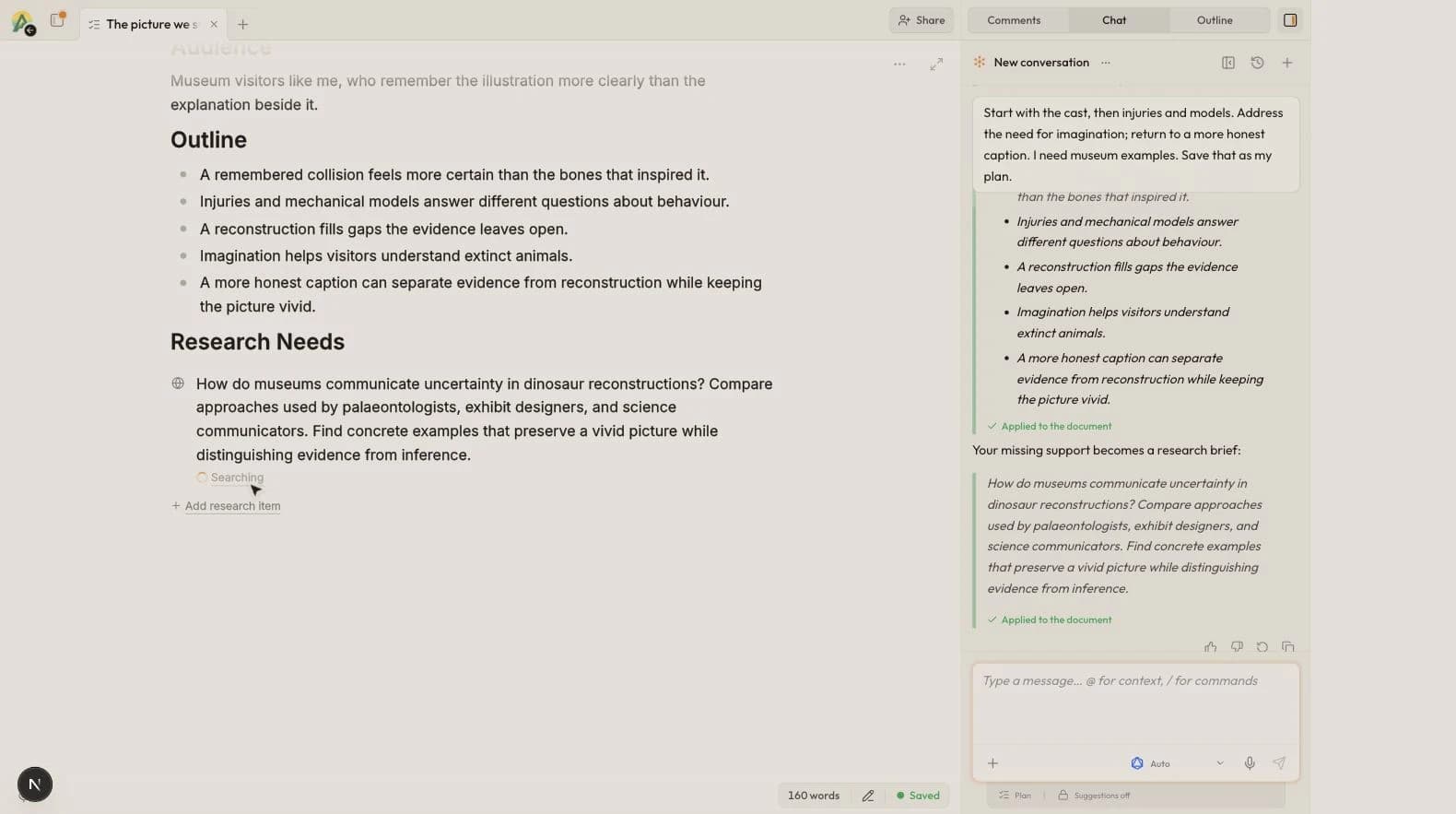
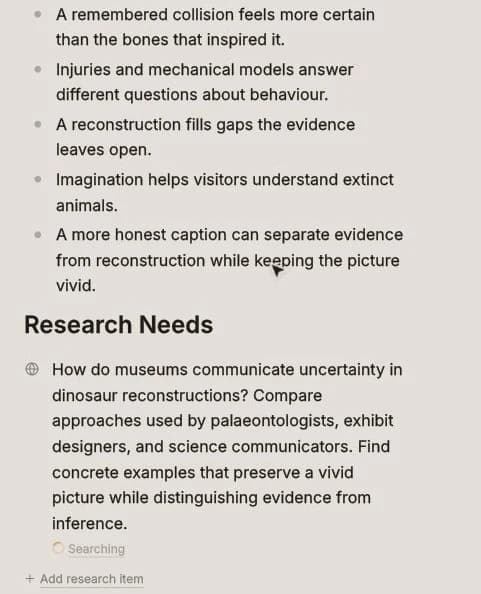
A writer brings unfinished thoughts about dinosaur reconstructions. Akston probes the intended reader effect, audience, and strongest objection. The writer chooses the argument and identifies missing museum examples, saves a thesis, audience, outline, and research brief to an editable Plan document, then starts research directly from that item. The research is shown in progress. Scripted demo; conversation condensed. Automatically repeats while visible unless reduced motion is enabled.
Answer probing questions, test an objection, and save your decisions as a clear plan. Then start research on the support you still need before drafting.
Planning principles
01
Begin with the hunches, questions, and convictions that made you want to write. Akston helps you find your central premise, clarify your theme, and say precisely what your piece is trying to do.
02
Akston helps you reach the people you are writing for. It researches what they think about your subject, where they will push back, and which topics, sources, and approaches are most likely to reach them.
03
Akston looks for claims you haven’t supported, assumptions you haven’t stated, and the strongest objections to your thesis, so you can deal with them before you write the draft.
04
Akston helps you organize your ideas into a logical outline, where each claim sets up the next. You see your whole argument at once and can fix its structure while that is still easy to change.
Built for the work before writing
Planning is where your argument takes shape. Each tool is designed to make your thinking more visible, more specific, and harder to fake.
Challenge
Akston looks for the assumption beneath your claim and asks the question that could change what your piece becomes.
Argument
Keep your premise, supporting claims, objections, and unanswered questions in view at once.
Structure
Move ideas until your argument carries the reader—without Akston writing your prose for you.
Alignment
A reverse outline maps the draft you actually wrote against the outline you planned, so a change of direction becomes your decision instead of an accident.
Start with an idea
Question it, clarify it, and give it a structure before you write a sentence.